The Closed-Lost Revival Office- How to Build a Persistent Revenue Recovery Function
A deep dive for CROs on structuring a cross-functional “revival office” that mines closed-lost deals with precision using intel, automation, and executive sponsorship.
The Closed-Lost Revival Office: How to Build a Persistent Revenue Recovery Function
Your board wants efficient growth, not just new logo fireworks. The fastest route? Turning your closed-lost column into a compounding revenue channel. In 2026 the best GTM teams have formalized this mandate into a “Closed-Lost Revival Office”-a recurring program that mines dormant deals with data, intent, and executive-level intimacy.

This guide lays out the structure, staffing, data backbone, and playbooks you need to run a revival office that produces reliable revenue every quarter.
1. Charter the Revival Office Like a Mission-Critical Pod
- Executive sponsor: CRO or SVP Sales to unblock resources.
- RevOps lead: Owns data hygiene, segmentation, and reporting.
- Revival captain (AE/AM hybrid): Manages outreach calendars, orchestrates plays.
- Enablement partner: Keeps assets updated and relevant to past objections.
Write a 1-page charter that defines the quarterly revenue target, number of accounts to revive, and success metrics (meetings booked, opportunities re-opened, ARR recovered).
2. Segment Closed-Lost with Prime Intelligence Layers
Enrich the archive beyond “Closed Lost – Reason: Budget.” Bring in:
- Commercial metadata – Contract value, discount fights, stakeholder map, mutual success plan.
- Intent signals – Technographic shifts, firmographic changes, job postings hinting at renewed priority.
- Engagement trail – Last assets consumed, meeting cadence, decision notes.
Feed this into a scoring model that ranks accounts by “Revival Probability.” Score ensures reps start with the highest-velocity wins.
3. Design Revival Motions for Each Stall Reason
| Stall Cause | Trigger Signals | Primary Motion | Supporting Assets |
|---|---|---|---|
| Budget freeze | Funding news, headcount growth | ROI recalibration workshop, timeline math | Board-friendly ROI calculator, new pricing tiers |
| Competitor selected | Onboarding complaints, user reviews, LinkedIn chatter | “Second look” exec call + implementation rescue plan | Competitive teardown one-pager, migration case study |
| Project deprioritized | Job changes, roadmap shifts | Problem resurfacing campaign led by product marketing | Insight brief, refreshed business case, customer council invite |
Document the plays in a shared Notion/Confluence, and preload sequences inside your follow-up platform.
4. Orchestrate Revival Weeks (and Make Them Famous Internally)
- Block one revival sprint per quarter (Monday prep, Tuesday-Thursday execution, Friday retro).
- Kick off with an all-hands briefing: target list, playbones, executive outreaches scheduled.
- Track daily momentum on a shared war-room dashboard.
- Celebrate re-opened deals on Slack-momentum is contagious.
5. Layer AI for Drafts, Intel Surfacing, and Risk Monitoring
- Draft co-pilot: AI suggests tailored revival emails referencing original objection, updated proof, and new CTA.
- Stakeholder resurfacing: AI monitors LinkedIn/job changes and alerts reps when champions move.
- Outcome explainability: Each revival attempt logs why it succeeded/failed; AI clusters insights for enablement.
Keep humans in the loop: revival touches must feel bespoke. AI accelerates prep, humans deliver empathy.
6. Measure the Office Like a Product Team
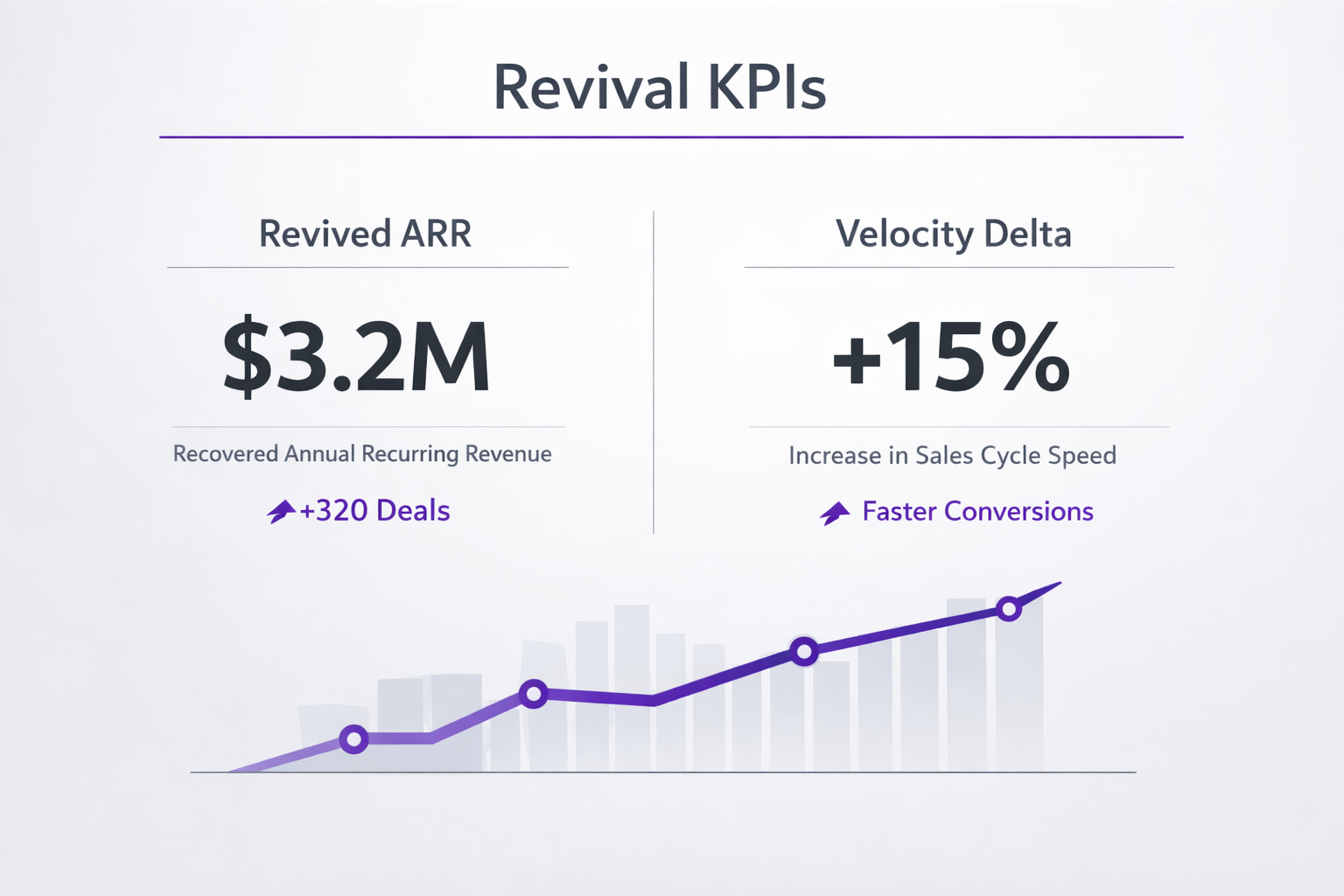
- Revived ARR – $ reopened and $ closed from revival motions.
- Velocity delta – Cycle time reduction compared to fresh pipeline.
- Win back rate – Percentage of revived opportunities closed vs. previously lost to competition.
- Playbook performance – Which motions generated the highest re-engagement.
Report these metrics monthly to the executive team. Treat the office like an internal product, iterating on features (plays, assets) based on performance.
7. Quick Start Checklist (Next 14 Days)
- Appoint your sponsor, RevOps owner, and revival captain.
- Pull the last 24 months of closed-lost opportunities, enrich with firmographic + intent data.
- Choose one stall reason and operationalize the motion (assets + outreach sequence).
- Schedule your first revival sprint with a narrow account list.
- Instrument a dashboard that tracks re-engagements and revived ARR.
The revival office is not a side project; it is a permanent muscle. Build it now, and your net retention curve-and valuation-follow.